In the vast multidisciplinary landscape of pulp and paper manufacturing—spanning plant genetics, fluid mechanics, and heavy process engineering—the chemical reactions occurring in the aqueous furnish suspension can easily be overlooked. However, treating paper chemistry as a minor variable is a costly operational mistake. Effective wet-end chemistry control is the decisive factor between a high-efficiency paper machine and one plagued by sheet defects, poor runnability, production losses, and ultimately, lost markets.
At the heart of this operational challenge lies the “0–5% Furnish Paradox.” With the exception of mineral fillers, papermakers add synthetic and natural chemical additives at levels of only 0–5% by weight of the furnish. Yet, because these specialty polymers, sizes, and resins carry a much higher unit cost than virgin fibre, recycled pulp, or filler, that tiny 0–5% fraction represents a massive proportion of a paper mill’s total raw material expenditure.
When chemical retention falters at the wet end, mills suffer a double penalty: expensive additives wash straight through the wire into the white water loop, and the final sheet fails to meet bulk and surface specifications. Here is how mill chemists and process engineers can master electrokinetics, navigate the alkaline shift, and deploy empirical control strategies to lock in both retention and profitability.
The Colloid Chemistry Challenge: Charge Demand & The Anionic Fines Trap
The chemistry of paper formation from aqueous suspensions of fibres, fillers, and furnish components is fundamentally a problem of physical and colloid chemistry. Whether an additive is designed to improve formation efficiency (like retention aids) or modify final product properties (like internal sizes, dyestuffs, opacifying pigments, or dry-strength resins), it cannot perform its job unless it is physically retained within the wet web.
Why Cationic Additives Dominate the Wet End
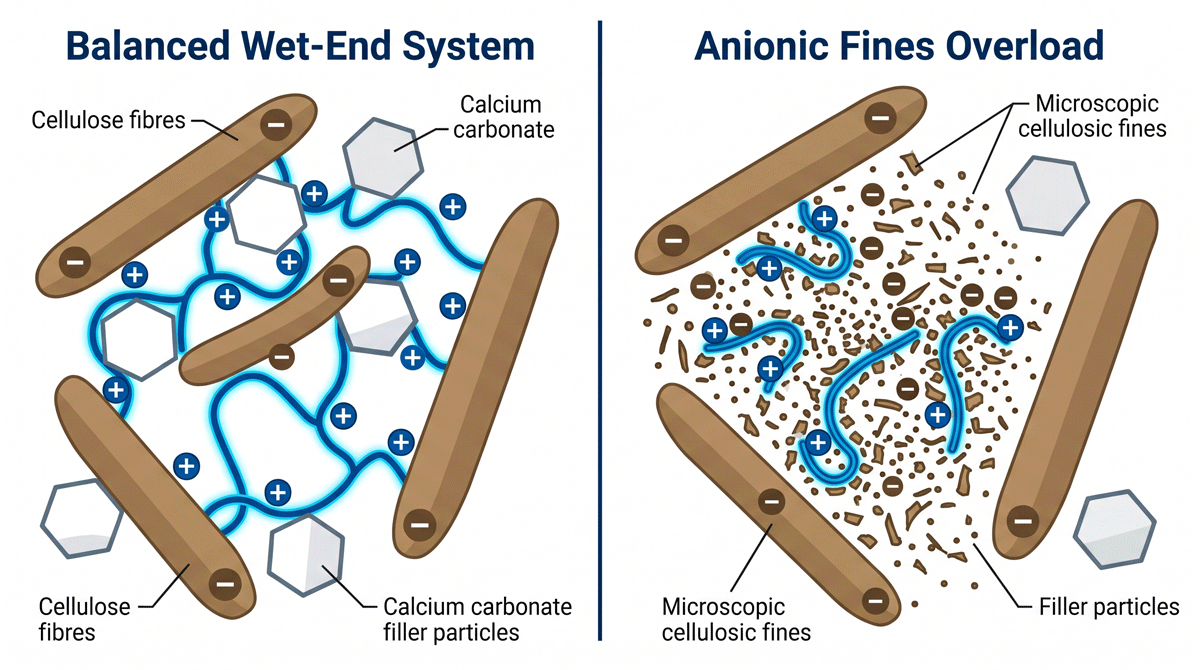
At normal papermaking pHs and in the absence of chemical treatment, the suspended particles that make up the furnish—cellulosic fibres, cellulosic fines, and mineral fillers—naturally carry a negative (anionic) surface charge.
To create a high electrostatic affinity for these negatively charged furnish components, wet-end chemical manufacturers engineer most functional and process additives to carry a positive (cationic) charge. These polymeric additives rely on electrokinetic adsorption onto particle surfaces to alter the state of flocculation of the dispersion, driving three critical formation mechanisms:
- Retention of microscopic fines and fillers within the fibre matrix.
- Accelerated dewatering on the forming wire.
- Wet web consolidation prior to pressing and drying.
The Anionic Fines Competition
If wet-end chemistry were simply a matter of dosing cationic polymers into an anionic fibre slurry, control would be effortless. The complication arises from the surface area and electrokinetics of fines.
Because fines possess a vastly higher specific surface area than long fibres, they exhibit a highly anionic nature. In the approach flow, these highly anionic fines aggressively compete with long fibre and filler surfaces to adsorb positively charged chemical species. If a mill experiences a sudden spike in fines—due to changes in refining intensity, broke addition, or deinked recycled pulp quality—the fines act as a chemical sponge, consuming expensive cationic sizes and strength resins before they can anchor to the structural fibres. Consequently, accurately determining the charge demand of the papermaking system is one of the most vital diagnostics in the mill.
How the Acid-to-Alkaline Shift Transformed Wet-End Control
From roughly 1840 until the early 1970s, papermaking was predominantly an acidic process operating at a pH of 4 to 5. This acidic environment was dictated by traditional internal sizing, which relied on rosin and aluminium sulphate (papermaker’s alum) to render the sheet resistant to aqueous fluid penetration. When dissolved in water, the dissociation of the hexahydrated aluminium ion naturally drives the solution pH to around 4.5, where alum also serves as a mildly effective retention aid.
Since the early 1970s, the industry has undergone an accelerating transition toward neutral and slightly alkaline pH systems, particularly across coated and uncoated printing and writing grades, linerboard, and aseptic liquid packaging boards.
Operational Advantages of Higher pH
- Reduced Machine Corrosion: Eliminating acidic alum solutions extends the lifespan of wet-end piping, headboxes, and forming hardware.
- Superior Fibre Swelling & Strength: Cellulosic fibres swell more effectively at higher pH, yielding stronger fibre-to-fibre bonding in the sheet.
- High Calcium Carbonate (CaCO3) Loading: Alkaline conditions allow mills to replace costly fibre with high levels of precipitated or ground calcium carbonate filler, which would otherwise decompose and foam in acidic systems.
- Drying Energy Savings: Because mineral fillers do not absorb water inside a lumen like cellulosic fibres, highly filled alkaline paper dewaters and dries much more easily, significantly cutting steam consumption in the dryer section.
New Chemical Complexities in Alkaline Systems
While the economics of alkaline papermaking are compelling, shifting the pH fundamentally alters wet-end chemistry control:
- Reactive Sizing Agents: Rosin-alum loses effectiveness at higher pH, requiring mills to switch to neutral/alkaline reactive sizes like Alkenyl Succinic Anhydride (ASA) or Alkyl Ketene Dimer (AKD), which require careful emulsion stabilization (often using cationic starch) and strict control of sizing development rates.
- Pitch and Slime Proliferation: Neutral and alkaline white water environments encourage biological slime growth and sticky pitch deposition, requiring targeted dosing of biocides and pitch-control agents.
- Compensating for Filler Strength Loss: Because high filler loading dilutes fibre-to-fibre bonding, alkaline mills rely heavily on dry-strength additives—primarily cationic starch and polyacrylamide (PAM). Due to its highly competitive price and dual ability to aid retention and drainage, mills consume roughly 20 times more cationic starch than polyacrylamide for dry strength.
| Wet-End Parameter | Traditional Acidic System | Modern Neutral / Alkaline System |
| Operating pH Range | pH 4.0 – 5.0 | Neutral to Slightly Alkaline (pH 7.0 – 8.5+) |
| Primary Sizing Chemistry | Rosin + Aluminium Sulphate (Alum) | Directly Reactive Sizes: AKD or ASA |
| Calcium Carbonate (CaCO3) Compatibility | Incompatible (causes dissolution) | Fully Compatible (enables high filler loading & CaCO3 coating broke) |
| Wet-Strength Resin Selection | Urea-Formaldehyde & Melamine-Formaldehyde | Polyamine-Polyamide-Epichlorohydrin (PAE) Resins |
| Fibre Swelling & Drying Energy | Lower fibre swelling; higher drying demand | Greater fibre swelling (higher strength); lower drying energy for filled sheets |
| Deposit & Corrosion Profile | High metal corrosion risk; lower biological slime | Reduced corrosion; higher tendency for pitch and microbiological slime deposits |
Why Theoretical Models Fail in Multi-Component Wet-End Systems
For decades, researchers have attempted to build a comprehensive physico-chemical model capable of predicting adsorption, flocculation, and retention at the wet end. As noted in Applications of Paper Chemistry (Section 1.3.7), generating a purely theoretical model that works on an industrial machine is neither currently possible nor likely to be achieved in the foreseeable future.
A paper mill’s wet end is not a clean, two-component laboratory beaker; it is a turbulent, multi-component additive system complicated by modern mechanical and environmental constraints:
- Closed White Water Systems: To minimize freshwater consumption and effluent discharge, modern mills tightly close their white water loops. This concentrates dissolved and colloidal substances, electrolytes, and unretained chemical additives, constantly shifting the ionic strength and charge balance of the aqueous environment.
- High-Speed & Twin-Wire Forming: Fast paper machines and twin-wire formers subject flocs to intense hydrodynamic shear, demanding multi-component retention systems that can rapidly reflocculate or form shear-resistant micro-flocs.
- Competing Chemical Cocktail: At any given second, the approach flow may contain cationic polyelectrolytes (polyacrylamides or polyethyleneimines), microparticle systems (colloidal silica paired with cationic starch), surface-active defoamers (polyethylene glycols, fatty acid esters/amides), optical brighteners, dyes, and wet-strength resins.
- Recycled Fibre & Environmental Carry-Over: Increasing inclusions of deinked recycled fibre introduce residual surfactants (alkyl phenol ethoxylates, polyphosphates), saponified fatty acid calcium soaps, and sodium silicate from peroxide bleaching. Simultaneously, mills must monitor environmental limits on free formaldehyde and Absorbable Organic Halogens (AOX) generated by the organo-chlorine content of epichlorohydrin (PAE) wet-strength resins.
With so many charged and surface-active molecules interacting simultaneously under high shear, purely theoretical equations break down.
Empirical Wet-End Chemistry Control Strategies That Actually Work
Because theoretical physico-chemical modeling cannot keep pace with dynamic furnish changes, successful wet-end chemistry control relies on empirical approaches driven by real-time instrumentation.
The core strategy is straightforward: identify the wet-end variables that directly govern chemical adsorption and flocculation, measure them continuously using online sensors, and feed those measurements into statistical process control (SPC) strategies or automated expert systems.
| Wet-End Additive / Variable | Primary Chemical Examples | Core Functional Role | Key Empirical Control Target |
| Retention & Drainage Aids | Cationic PAM, Polyethyleneimine (PEI), Colloidal Silica + Cationic Starch | Flocculates fines and fillers; accelerates wire dewatering | White water consistency, first-pass retention, & online drainage rate |
| System Charge Demand | Anionic fines, fibres, fillers vs. Cationic polyelectrolytes | Governs electrostatic adsorption of all charged additives onto the web | Online cationic/anionic charge demand titration (streaming current/zeta potential) |
| Dry-Strength Additives | Cationic Starch (dominant 20:1), Polyacrylamide (PAM) | Offsets strength loss in high-filler sheets; aids retention & size stabilization | Starch-to-furnish ratio, charge neutralization point, and dry tensile/burst specs |
| Internal Sizing Agents | AKD, ASA (Alkaline); Rosin + Alum (Acidic) | Renders bulk sheet resistant to aqueous fluid penetration | System pH, emulsion stability, retention rate, and on-machine cure rate |
| Wet-Strength Resins | PAE (Neutral/Alkaline); U/F & M/F (Acidic) | Maintains sheet integrity when saturated (packaging, sacking, tissue) | System pH, resin retention, and effluent AOX / free formaldehyde levels |
| Deposit & Foam Control | Biocides, Pitch Dispersants, PEG & Fatty Acid Amide Defoamers | Prevents air entrapment in approach flow and slime/pitch breaks on wire | Entrained air sensors, microbiological ATP counts, and machine runnability |
3 Pillars of an Empirical Wet-End Control Loop
- Continuous Charge Demand Monitoring: By installing online charge analyzers in the thick stock and headbox approach flow, chemists can track fluctuations in anionic trash and fines loads in real time. When anionic charge demand spikes (for instance, when switching to a higher ratio of coated broke or deinked pulp), the control loop can automatically adjust a high-charge cationic coagulant or fixative before expensive functional additives like ASA or PAE are neutralized.
- Real-Time Retention & White Water Tracking: Optical consistency transmitters measuring headbox solids versus tray white water solids allow the mill’s Distributed Control System (DCS) to calculate fines and filler retention continuously. Rather than running a fixed polymer dosage per tonne of paper—which either starves the sheet during upsets or wastes polymer during stable runs—the retention aid pump modulates dynamically to hold white water consistency constant.
- Statistical Control & Expert Systems: By logging pH, conductivity, charge demand, retention aid flow, and vacuum box drainage profiles together, mill chemists can establish statistical operating windows. Expert control systems use these empirical correlations to prevent over-flocculation (which ruins sheet formation) while keeping raw material chemical costs strictly within budget.
Frequently Asked Questions (FAQ) on Wet-End Chemistry Control
1. Why is wet-end chemistry control critical if additives are only 0–5% of the furnish?
Although chemical additives (excluding fillers) account for only 0–5% of the furnish by weight, their high unit price makes them a major component of total raw material costs. Poor wet-end control leads to low additive retention, chemical overdosing, pitch and slime deposits, poor sheet dewatering, and severe quality deficiencies.
2. How do anionic fines interfere with cationic paper chemicals?
At normal papermaking pHs, fibres, fillers, and fines carry a negative (anionic) charge. Because fines have an exceptionally high specific surface area and a strongly anionic nature, they aggressively compete with long fibres and fillers to adsorb positively charged (cationic) additives. Without proper charge demand control, fines consume excessive amounts of cationic starch, sizing emulsions, and retention polymers.
3. Why can’t paper mills use a single theoretical formula to control the wet end?
Modern paper machines operate with complex multi-component additive systems, high-speed twin-wire formers, and tightly closed white water loops. The simultaneous physical and electrokinetic interactions between starches, synthetic polyelectrolytes, colloidal silica, sizing emulsions, and recycled pulp contaminants are too complex for a comprehensive physico-chemical model, making empirical sensor-based control necessary.
4. Why do mills use 20 times more cationic starch than polyacrylamide for dry strength?
Cationic starch is overwhelmingly favored over synthetic polyacrylamide (PAM) due to its highly competitive cost and multi-functional behavior in the wet end. In addition to boosting dry strength in high-filler alkaline papers, cationic starch acts as a drainage and retention aid, serves as a key component in colloidal silica microparticle systems, and stabilizes AKD and ASA sizing dispersions.
5. How does shifting from acid to alkaline papermaking change wet-end chemical selection?
Moving from acidic pH (4–5) to neutral/alkaline pH requires replacing rosin and aluminium sulphate (alum) with reactive sizes like AKD or ASA. It also requires switching from U/F or M/F wet-strength resins to alkaline-compatible PAE resins, increasing dry-strength additives to offset high calcium carbonate filler levels, and implementing stronger biocide and pitch control programs.