Wood is the principal source of cellulosic fiber for pulp and paper manufacture. At present, wood provides about 90% to 95% of the world’s virgin fiber requirement. For paper technologists and mill chemists, understanding the raw material at a cellular level is not just academic—it is essential for optimizing the pulping process.
A tree can be considered to have three general parts: the crown composed of leaves and branches, the stem, and the root system. The leaves or needles are the factories where food material is manufactured through photosynthesis to provide the tree with energy and growth. Although the crown is the regulating center, wood is not produced directly by photosynthesis; rather, wood results through cell divisions of the vascular cambium using energy derived from the products of photosynthesis. After cambial division, each successive cell undergoes enlargement, wall thickening, and lignification. This article explores how the distinct anatomical layers of a tree—specifically the cambium, sapwood, heartwood, and bark—directly influence chemical pulping efficiency, liquor penetration, and final pulp quality.
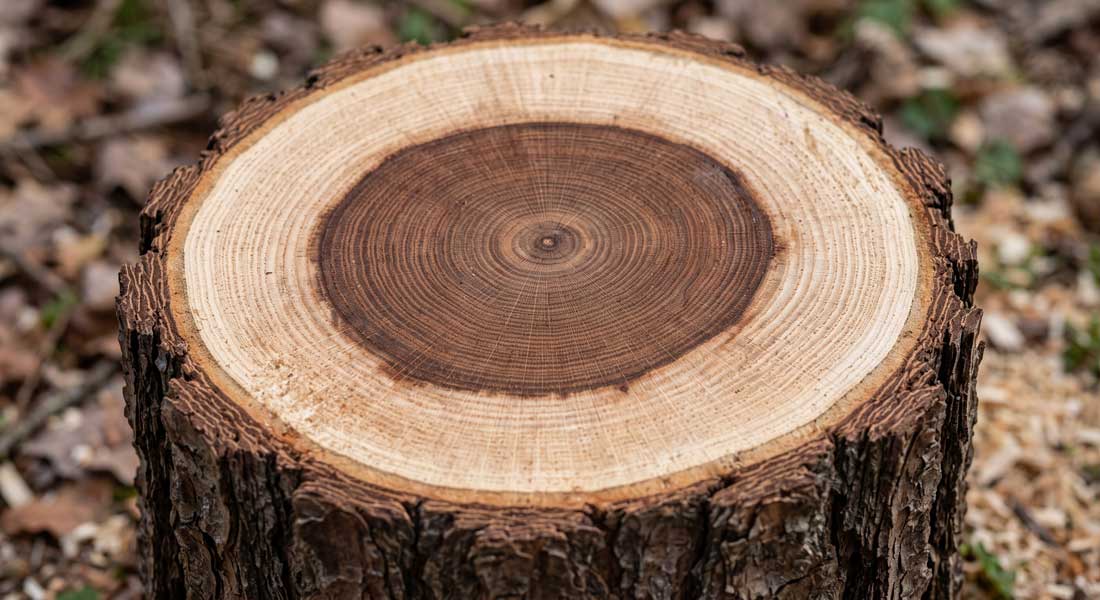
The Vascular Cambium: The Birthplace of Wood Fibers
The cambium consists of a thin layer of tissue between the bark and the inner sapwood. This microscopic layer is the biological engine of wood production. In temperate climes, the rate of cambial growth varies with the seasons giving rise to the deposition of thin-wall fiber cells in the spring and more dense thick-wall fibers in the fall. The cambium is dormant during the cooler months of the year. This seasonal variation is critical for papermaking, as it dictates the ratio of earlywood to latewood in the chip furnish. The yearly growth cycle is reflected in the annual rings, the total number of which represent the tree’s age.
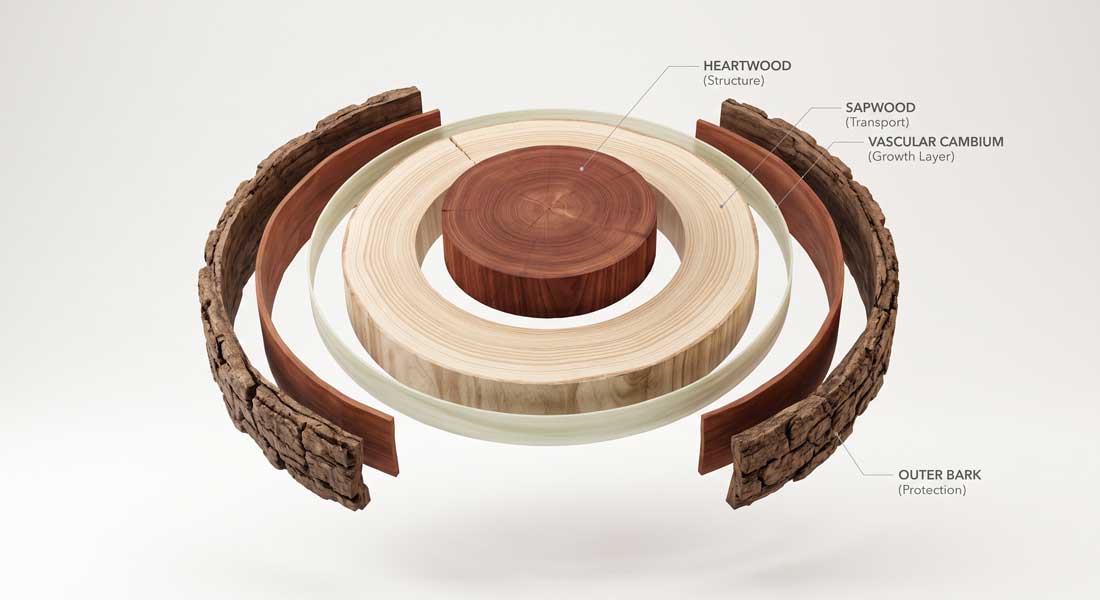
Sapwood vs. Heartwood in Chemical Pulping
The structural wood of the stem is divided into two distinct zones that behave very differently inside a digester.
Sapwood Characteristics and Advantages
The sapwood portion of the tree provides structural support for the crown, acts as a food storage reservoir, and provides the important function of water conduction up from the roots. Because it is physiologically active (parenchyma cells only) and in continuous communication with the cambium and phloem through sap flow, it generally presents an open cellular structure. For a pulp mill, this means cooking liquors can penetrate sapwood chips relatively easily, leading to a more uniform cook.
The Challenges of Heartwood
In contrast, the inner heartwood is a core of dead woodcells in the center of the stem whose physiological activity has ceased. It functions only as mechanical support.
Heartwood is usually much darker in color than sapwood due to deposition of resinous organic compounds in the cell walls and cavities. Such deposition makes liquor penetration during chemical pulping more difficult in heartwood than in sapwood. This resistance often requires careful adjustment of pulping parameters (such as temperature, pressure, or chemical charge) to prevent high reject rates. In a few species (most notably spruce) the color difference between heartwood and sapwood is minor. At the center of the tree is a small core of soft tissue called the pith.
The Role of the Bark System
Bark is the outer covering or rind of woody stems and branches. It is distinct and separable from wood. The structure is complex (as compared to wood) because bark contains three types of tissue (cortex, periderm and phloem), each of which has several types of cells.
Inner Bark (Phloem)
The inner bark (phloem) is a narrow layer of tissue where the carbohydrate-containing sap moves upward and downward through sieve tubes and rays.
Outer Bark (Cork)
The outer bark is a collection of dead cells which originally existed in the inner living bark; it is composed of a variety of extraneous components in addition to cellulose, hemicellulose and lignin.
Why Bark is a Major Contaminant in Pulp Operations
While bark generally is considered to be a contaminant in pulping operations, some types (e.g., western red cedar and aspen) contain significant quantities of fiber and can be tolerated to an extent in an alkaline pulping system. However, introducing bark into the digester creates severe operational bottlenecks.
Certain bark constituents are resistant to typical pulping conditions, principally cork cells, dense sclereids or “stone cells”, and cells impregnated with extractives. This resistance creates three primary issues for mill operations:
- Chemical Waste: The extractives consume relatively large amounts of chemical.
- Poor Pulp Quality: Partially pulped particles remain as dirt in the finished pulp.
- Process Inefficiency: Greater amounts of bark are tending to be introduced into the pulp mill with the chip furnish because of more intense tree utilization (e.g., whole-tree chipping).
To maintain high-quality output, techniques are employed in the pulp mill to remove bark from the wood chips and remove bark specks from the pulp.
Conclusion
The physical architecture of a tree dictates how it will react under industrial pulping conditions. From the highly penetrable sapwood to the resistive heartwood and the chemically demanding bark, every layer requires specific attention during processing. By understanding these morphological characteristics, mill engineers and chemists can better optimize debarking, adjust cooking liquor penetration strategies, and ultimately produce a cleaner, stronger paper product.