The pulp and paper industry has shaped human civilization for nearly 2,000 years. Understanding the milestones in pulp and paper industries development isn’t just a look back at history; it’s a roadmap for the future of sustainable manufacturing. As we move through 2026, the industry is undergoing another radical shift—transitioning from mass production to “smart” production.
From the invention of early papermaking in ancient China to today’s AI-powered this sector helps us appreciate how paper became one of the world’s most essential materials for communication, packaging, hygiene, and industrial applications.
This article explores the key developments, historical breakthroughs, revolutionary technologies, and sustainability shifts that defined the pulp and paper industry—backed by real facts, examples, and global impact.
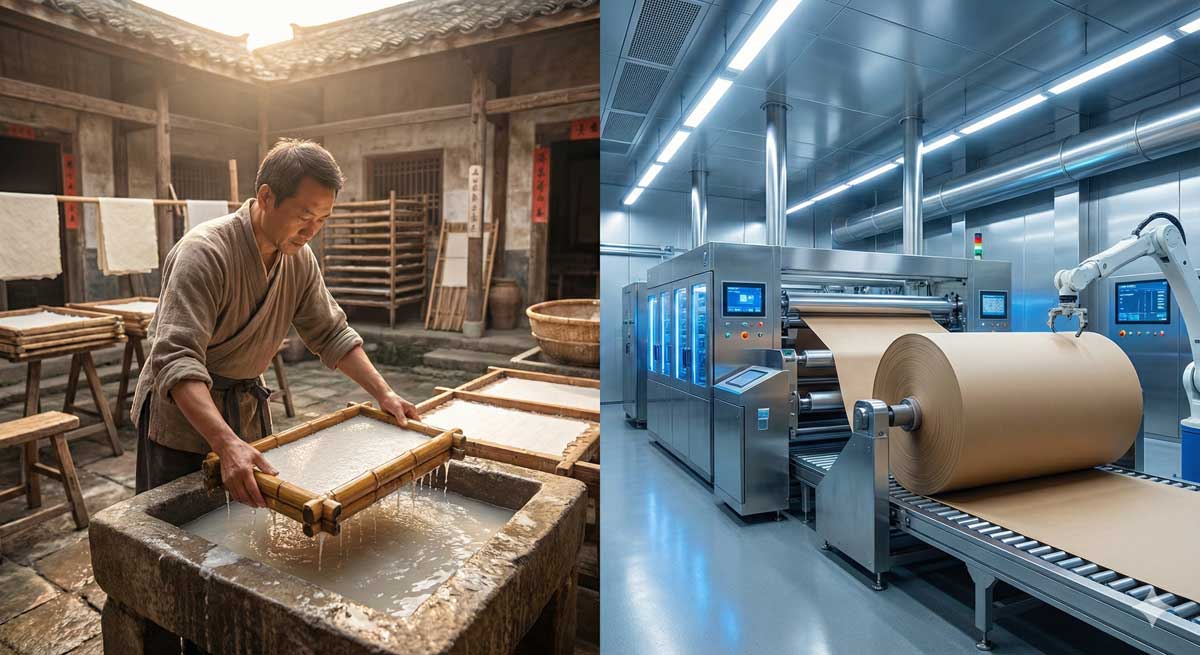
Ancient Origins: The Birth of a Medium (105 CE – 8th Century)
The first and perhaps most significant milestone occurred in 105 CE in Lei-Yang, China. While rudimentary “pre-paper” materials like papyrus and parchment existed, it was Cai Lun, a Chinese court official, who is credited with inventing the true papermaking process.
The Cai Lun Innovation
Cai Lun’s genius was in the recipe. He mixed mulberry bark, hemp, and old rags with water, mashed them into a pulp, and pressed the mixture through a screen. The resulting thin mat was dried in the sun, creating a lightweight, flexible, and affordable writing surface.
The Medieval Leap: Water Power and European Expansion
By the 12th century, papermaking reached Europe via Spain and Italy. This era marked a shift from manual mashing to mechanical assistance.
The Rise of the Paper Mill
In the 1200s, Italian papermakers in Fabriano introduced several critical technical milestones:
- Water-Powered Stamp Mills: Using waterwheels to power heavy hammers that beat rags into pulp more efficiently than human hands.
- Animal Sizing: Coating paper with gelatin to prevent ink from “bleeding” into the fibers.
- Watermarking: A technique for branding and quality control that is still used in currency today.
The Industrial Revolution: Mechanization (1799 – 1850)
Until the late 18th century, every single sheet of paper in the world was made one by one by hand. The demand for books and newspapers during the Enlightenment made this process a bottleneck for progress.
The Fourdrinier Machine
In 1799, Louis-Nicolas Robert in France patented a machine to produce “endless” paper. However, it was refined and commercialized in England by Sealy and Henry Fourdrinier. The Fourdrinier machine replaced the manual vat with a moving conveyor belt of wire mesh. This allowed for a continuous web of paper to be formed, pressed, and dried in one go.
Stat Check: By 1830, mechanized mills could produce paper at a rate 10 times faster than the most skilled hand-vats, drastically lowering the price of newspapers.
The Raw Material Shift: From Rags to Wood (1840 – 1880)
As the printing press became faster, the world literally ran out of rags. In the mid-19th century, the industry faced a “rag crisis,” leading scientists to look for alternative fibers.
- The Discovery of Wood Pulp: In 1844, Friedrich Gottlob Keller in Germany developed a machine to grind wood into a fibrous “groundwood” pulp. However, mechanical pulp was brittle and yellowed quickly. The solution lay in chemistry.
- 1854 (Soda Process): Using caustic soda to cook wood chips and dissolve lignin. It is the First chemical method for wood pulp.
- 1867 (Sulfite Process): Using sulfurous acid for a higher-quality, whiter pulp. Improved brightness and strength.
The Kraft Process: The Backbone of Modern Packaging (1879)
In 1879, Carl F. Dahl in Germany discovered that adding sodium sulfate to the pulping process created an incredibly strong fiber. He called it the “Kraft” process (German for “strength”). Today, 80%+ of chemical pulp worldwide is kraft pulp. This was a massive milestone because:
- It allowed for the use of resinous woods like pine.
- It recovered its own chemicals, making it more cost-effective.
- It gave birth to the modern corrugated cardboard and brown paper bag industries.
The Sustainability and Digital Era (1990 – 2026)
In the late 20th century, the industry shifted its focus from “more” to “better.” Environmental regulations and the digital revolution forced a complete rethink of the pulp and paper lifecycle.
Milestone: The Circular Economy
Since 1990, the paper industry has become a leader in recycling.
- Stat: In the U.S., the paper recycling rate has consistently hovered above 65%, nearly 60% higher than in 1990.
- Energy Efficiency: Since 2005, the industry has reduced its total energy use by over 12% by utilizing biomass residuals (black liquor) as a renewable fuel source.
Industry 4.0 and Automation
As of 2024–2026, the primary milestone is Digital Transformation. Modern mills are now “Smart Mills” using:
- AI & Machine Learning: Predictive maintenance to prevent downtime and sensors to optimize fiber usage.
- IIoT (Industrial Internet of Things): Real-time monitoring of wood chip moisture and chemical levels.
- Alternative Fibers: The rise of bamboo, straw, and even stone paper as the industry seeks to reduce its reliance on traditional timber.
Conclusion: The Future is Fiber-Based
The milestones in pulp and paper industries development show an industry that is remarkably resilient. From a simple tool for recording history, paper has evolved into a high-tech solution for the world’s plastic crisis. As we look toward 2030, the “Next Big Milestone” is likely the complete decarbonization of the pulping process and the expansion of nanocellulose—a material stronger than steel but made from wood fiber. The industry is no longer just about “paper”; it is about the sustainable management of our planet’s most versatile renewable resource.
FAQ: People Also Ask
1: Who invented the modern papermaking process?
While Cai Lun invented paper in 105 CE, the modern mechanized process was established by the Fourdrinier brothers and Bryan Donkin in the early 1800s.
2: What was the most important milestone in the 19th century?
The shift from rags to wood pulp (mechanical and chemical) was the most critical, as it allowed for the mass production of paper to meet the demands of a literate global population.
3: What is the Kraft process and why is it important?
The Kraft process is a chemical pulping method that produces exceptionally strong fibers. It is the dominant method used today to create cardboard, shipping boxes, and heavy-duty bags.
4: Is the paper industry still growing despite digitalization?
Yes. While “graphic paper” (for printing) has declined, the demand for “packaging and tissue paper” is surging due to the growth of e-commerce. The market is expected to reach over $391 billion by 2032.
5: How is AI being used in paper mills today?
AI is used for predictive maintenance (predicting when a machine will break), quality control via computer vision, and optimizing chemical usage during the pulping phase to reduce waste.