Modern pulp and paper manufacturing draws on an extraordinary range of scientific disciplines, from plant genetics and biochemistry to fluid mechanics and process engineering. Looking at a massive, high-speed paper machine, it is easy to assume that the trace chemicals added to the pulp slurry play a minor role in the overall technology. On the production floor, the exact opposite is true.
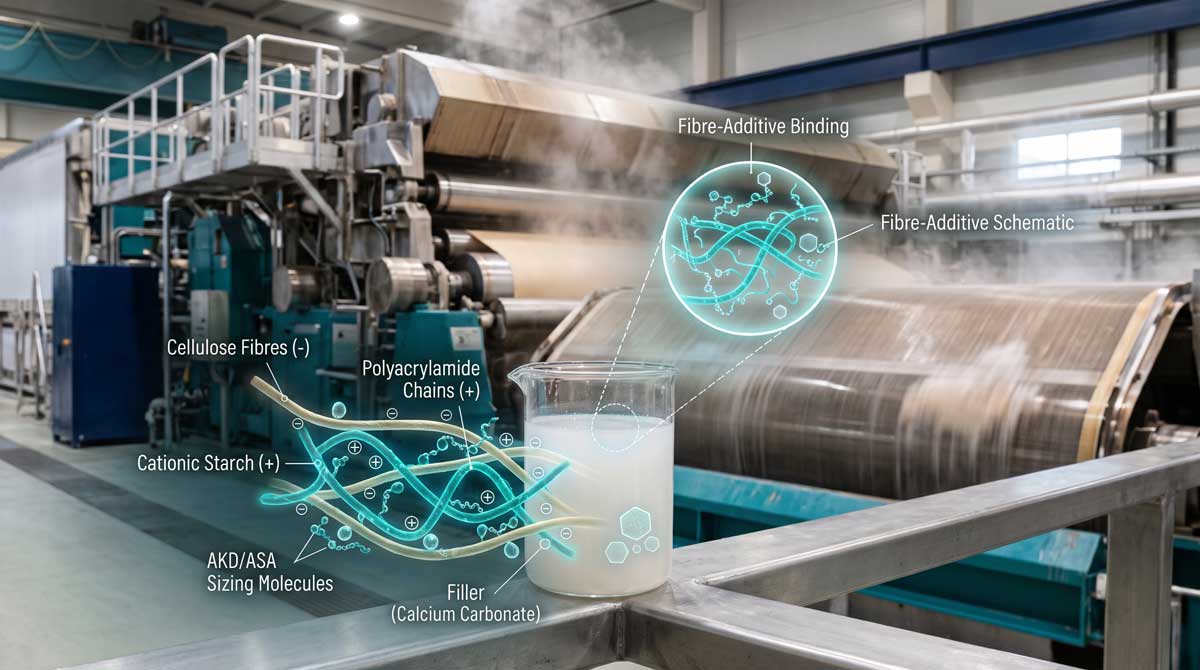
The chemistry of pulp and paper manufacturing falls into four distinct operational zones: pulping, recycling, paper formation, and finishing. The third stage—forming a continuous paper sheet from an aqueous suspension of fibres, fillers, and furnish components—is the domain of wet-end chemistry.
With the exception of mineral fillers, papermakers dose synthetic and natural wet-end chemicals at levels of just 0 to 5% by weight of the furnish. Because these specialty molecules are significantly more expensive than virgin fibre or filler, they make up a substantial portion of a mill’s raw material budget. Choosing the right wet-end chemicals—and ensuring they stay in the sheet—is essential for maintaining machine speed, meeting strict physical specifications, and protecting mill profitability.
How Wet-End Chemicals Work: Process Aids vs. Functional Modifiers
Before examining individual chemical families, mill chemists divide wet-end additives into two operational categories based on their primary purpose in the furnish:
- Formation & Process Efficiency Additives: These chemicals optimize how the wet web forms on the machine wire, focusing on the retention of microscopic fines, accelerated dewatering, foam suppression, and wet web consolidation.
- Product Modification (Functional) Additives: These chemicals alter the physical or optical properties of the finished paper sheet. They range from small organic molecules (such as internal sizes and dyestuffs) and inorganic opacifying pigments to complex polymers like dry- and wet-strength resins.
Bulk Modification vs. Surface Treatment
Where a chemical is added determines how it modifies the sheet. Chemicals introduced at the wet end are designed to modify the bulk properties of the entire paper structure, whereas additives applied later at the size press or coating station modify predominantly surface properties.
Whether a wet-end chemical is water-soluble or prepared as an aqueous suspension (such as a sol or emulsion), it must be physically retained in the wet web to function. Because cellulosic fibres, fines, and fillers naturally carry a negative (anionic) charge in water at normal pHs, most wet-end chemicals are engineered with a positive (cationic) charge so they adsorb tightly onto particle surfaces.
Core Types of Wet-End Chemicals and Their Functions
As paper mills have transitioned from traditional acidic environments (pH 4–5) toward neutral and slightly alkaline operations, the lineup of wet-end chemicals has evolved rapidly. Below are the primary chemical classes used in modern papermaking.
1. Retention and Drainage Aids
Over recent decades, retention and drainage aids have seen faster growth than almost any other chemical additive in the paper industry. This surge is driven by faster paper machines, twin-wire forming, higher mineral filler loading in alkaline systems, and the widespread use of recycled fibre.
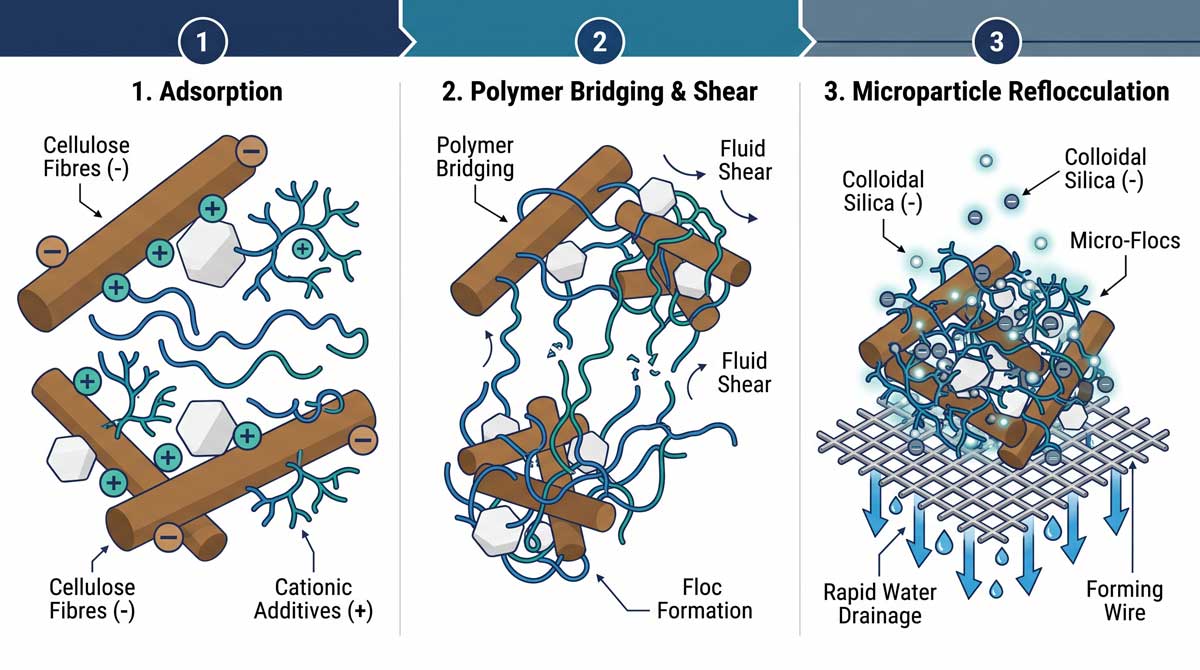
Retention aids work by adsorbing onto negatively charged particle surfaces and inducing controlled flocculation. While cationic, neutral, and anionic polymers can be used singly or in tandem, cationic polyelectrolytes dominate the market:
- Polyacrylamides (PAM) and Polyethyleneimines (PEI): The market-leading synthetic polymers for bridging fibres, fines, and fillers.
- Colloidal Silica Microparticle Systems: Increasingly used in multi-component addition strategies alongside cationic starch to deliver high retention and rapid wire drainage.
2. Dry-Strength Additives
When mills increase calcium carbonate filler levels to save fibre and cut drying energy, the mineral particles interfere with natural fibre-to-fibre hydrogen bonding. Dry-strength additives restore that lost structural integrity.
- Cationic Starch: Driven by its competitive price, starch is overwhelmingly the dominant dry-strength additive in papermaking. Mills consume roughly 20 times more starch than polyacrylamide for dry strength. Because wet-end starches are almost exclusively cationic, they also function as secondary retention and drainage aids and help stabilize sizing dispersions.
- Polyacrylamides (PAM): Synthetic polymers used where targeted dry-strength reinforcement is required alongside cationic starch.
3. Internal Sizing Agents
Internal sizing renders the paper sheet resistant to the penetration of aqueous fluids like printing inks or beverage liquids. Sizing chemistry is strictly dictated by the pH of the wet end:
- Rosin and Aluminium Sulphate (Alum): From around 1840 to the early 1970s, most paper was sized at pH 4–5 using rosin and alum. In water, the hexahydrated aluminium ion dissociates to create an acidic pH around 4.5 while acting as a mild retention aid. While declining in Europe and North America, rosin-alum remains widely used in Japan and in naturally acidic groundwood grades.
- Alkyl Ketene Dimer (AKD) and Alkenyl Succinic Anhydride (ASA): Directly reactive synthetic sizes that thrive at neutral and slightly alkaline pHs. AKD dominates European alkaline mills, whereas North American mills utilize both AKD and rapidly growing volumes of ASA.
4. Wet-Strength Resins
Grades exposed to water during use—such as sacking, packaging boards, poster papers, and sanitary tissues—require wet-strength additives to prevent the sheet from disintegrating when saturated.
- Urea-Formaldehyde (U/F) and Melamine-Formaldehyde (M/F): Traditional thermosetting resins suited for acidic wet-end systems.
- Polyamine-Polyamide-Epichlorohydrin (PAE) Resins: The standard wet-strength chemistry for neutral and alkaline papermaking.
- Environmental Considerations: Both chemistries face environmental scrutiny—U/F and M/F resins contain traces of free formaldehyde, while the organo-chlorine content in epichlorohydrin resins produces measurable Absorbable Organic Halogens (AOX) in mill water systems and finished products.
5. Defoamers, Biocides, and Pitch Control Agents
Runnability chemicals keep the approach flow clean and prevent web breaks.
- Defoamers: Surface-active agents—primarily polyethylene glycols (PEGs) and esters or amides of fatty acids—prevent entrained air and surface foam in the approach flow, during sheet formation, and in coating kitchens.
- Biocides and Pitch Control: Neutral and alkaline systems, as well as recycled furnishes, are highly prone to microbiological slime and sticky pitch deposits, requiring continuous biocide and pitch dispersant dosing.
6. Deinking and Recycling Chemicals
While deinking takes place in the recycling plant rather than the paper machine headbox, residual deinking chemicals directly impact wet-end chemistry. Performed at alkaline pHs, deinking relies on two primary mechanisms:
- Wash Deinking: Uses dispersants or surfactants—most commonly alkyl phenol ethoxylates and, to a lesser degree, polyphosphates—to detach ink particles and wash them from the pulp matrix.
- Flotation Deinking: Uses saponified fatty acids in the presence of calcium ions to make ink particles hydrophobic, attaching them via collector molecules to air bubbles that float to the surface as a removable foam.
- Bleaching & Stabilizers: Deinking lines frequently brighten pulp using sodium hypochlorite or hydrogen peroxide, with the latter requiring sodium silicate for chemical stabilization.
Summary Table: Wet-End Chemical Classes at a Glance
| Chemical Category | Primary Chemical Compounds | Main Function in the Sheet / Machine | Typical Operating pH |
| Retention & Drainage Aids | Cationic PAM, PEI, Colloidal Silica + Cationic Starch | Flocculates fines/fillers and speeds wire dewatering | Acidic, Neutral, or Alkaline |
| Dry-Strength Agents | Cationic Starch (dominant 20:1), Polyacrylamide | Restores dry strength in high-filler sheets; aids retention | Neutral to Alkaline (primarily) |
| Internal Sizing (Acid) | Rosin + Aluminium Sulphate (Alum) | Resists aqueous fluid penetration; mild retention aid | Acidic (pH 4.0 – 5.0) |
| Internal Sizing (Alkaline) | AKD (Alkyl Ketene Dimer), ASA (Alkenyl Succinic Anhydride) | Directly reactive sizing for calcium carbonate-filled sheets | Neutral to Slightly Alkaline |
| Wet-Strength Resins | U/F, M/F (Acid); PAE Epichlorohydrin (Alkaline) | Preserves sheet strength when wet; monitors AOX/formaldehyde | Grade & pH dependent |
| Defoamers | Polyethylene Glycols, Fatty Acid Esters & Amides | Eliminates foam in approach flow, wire, and coating | All pH ranges |
| Tissue Softeners | Quaternary Ammonium Compounds (long-chain alkyl) | Debonds fibres to improve softness in recycled tissue | Neutral / Alkaline |
| Deinking Chemicals | Alkyl Phenol Ethoxylates, Fatty Acid Soaps + Ca2+, H2O2 + Silicate | Detaches and floats ink from recycled waste paper | Alkaline |
Applications of Wet-End Chemicals by Paper and Board Grade
The global market for paper chemicals closely mirrors the production volume and growth of specific paper and board grades across North America, Western Europe, the Nordic countries, and Japan. Each product grade requires a customized chemical recipe.
1. Newsprint
Historically, newsprint mills used minimal wet-end additives. Because newsprint is an unsized, low-cost commodity made from naturally acidic groundwood pulp, expensive retention aids were rarely considered cost-effective.
However, rising inclusions of mineral fillers and deinked waste paper have changed newsprint chemistry. Today, newsprint mills use retention aids primarily for environmental compliance (keeping white water clean) rather than raw material savings alone. Furthermore, calcium carbonate carry-over from recycled fibre is gradually nudging acidic newsprint systems toward higher pHs.
2. Printing and Writing Grades (Coated & Uncoated)
Commercial printing, lightweight coated (LWC) advertising magazines, computer print-out, and office copier papers represent one of the largest markets for wet-end chemicals. Most of these mills have converted to neutral or slightly alkaline systems to take advantage of high calcium carbonate filler loading and ensure compatibility with calcium carbonate-based coating broke.
This alkaline shift requires AKD or ASA sizing, alkaline-compatible retention polymers, biocides for slime and pitch control, and heavy dosages of cationic starch and PAM to counteract filler-induced strength loss. In coated grades, mills have also shifted from natural coating binders (starch and carboxymethyl cellulose) toward synthetic polymers like acrylates, styrene-butadiene copolymers, and polyvinyl alcohols/acetates for superior gloss.
3. Tissue and Sanitary Products
Consumer demand has driven a massive increase in recycled fibre usage in tissue manufacturing. Because recycled pulp produces a stiffer, harsher sheet than virgin fibre, tissue softening chemicals have become critical.
The most popular chemical softeners are debonding agents—cationic, water-soluble hydrophobic molecules that bind to cellulosic fibres and deliberately interfere with hydrogen bonding to create a softer feel. Quaternary ammonium compounds featuring hydrophobic, long-chain alkyl substituent groups are the workhorses of this category, supported by wet-strength resins and pitch/biocide packages.
4. Packaging and Board Grades
Packaging and linerboard mills—especially in Europe—rely heavily on recycled waste paper, making pitch control, slime control, and deinking chemistry essential. High-performance boards, such as aseptic liquid packaging board for juice cartons and fast-food containers, operate under alkaline conditions using synthetic sizing and dual wet- and dry-strength systems. In these grades, the rate of sizing development on the machine and strict compliance with food-contact chemical regulations are top priorities.
Conclusion
Wet-end chemicals may only represent 0 to 5% of the papermaking furnish by weight, but they dictate both the runnability of the paper machine and the commercial quality of the final product. By matching the right combination of retention polymers, cationic starch, reactive sizes (AKD/ASA), and wet-strength resins to the pH and grade requirements of the mill, papermakers can maximize filler loading, cut drying energy, and turn complex recycled furnishes into high-value paper and board.
Frequently Asked Questions (FAQ)
1. What is the difference between wet-end chemicals and surface chemicals in papermaking?
Wet-end chemicals are added to the aqueous pulp slurry before sheet formation to modify the bulk properties of the entire sheet or improve wire drainage and retention. Surface chemicals are applied later at the size press or coating station to modify only the surface properties of the paper, such as gloss or printability.
2. Why are most wet-end paper chemicals positively charged (cationic)?
At normal papermaking pHs, cellulosic fibres, fines, and mineral fillers naturally carry a negative (anionic) surface charge in water. Wet-end additives are engineered with a positive (cationic) charge so they are electrostatically attracted to the negatively charged furnish components, ensuring high retention in the wet web.
3. How do tissue mills make recycled toilet and facial tissue soft?
Recycled fibres tend to form stiff, rough sheets. Tissue mills add chemical debonding agents—most commonly quaternary ammonium compounds with long-chain hydrophobic alkyl groups—which attach to the fibres and partially block fibre-to-fibre bonding, increasing sheet softness.
4. What are the environmental concerns with wet-strength resins in paper mills?
Traditional acidic wet-strength resins like urea-formaldehyde (U/F) and melamine-formaldehyde ($M/F$) contain trace levels of free formaldehyde. Alkaline polyamine-polyamide-epichlorohydrin (PAE) resins contain organo-chlorine, which contributes to measurable Absorbable Organic Halogens (AOX) in mill water loops and paper products.
5. Why did printing and writing paper mills switch from Rosin-Alum to AKD and ASA sizing?
Printing and writing mills shifted from acidic (pH 4–5) to neutral and alkaline pH to use high levels of calcium carbonate filler, reduce machine corrosion, increase fibre swelling strength, and save drying energy. Because rosin and alum do not function effectively at high pH, mills adopted alkaline-reactive sizes like AKD and ASA.