Cellulosic fibers are the fundamental building blocks of the global paper and pulp industry. Extracted primarily from plant life and wood, these natural polymers possess a unique combination of physical and chemical characteristics that make them exceptionally suited for forming durable, versatile networks. Cellulosic fibers exhibit a number of properties which fulfill the requirements of papermaking. The behavior of these fibers—particularly how they interact with water, respond to mechanical stress, and bond with one another—dictates the final quality, strength, and functionality of both traditional paper products and advanced cellulosic biomaterials.
Chemical Composition and the Ideal Papermaking Balance
To understand the behavior of cellulosic fibers, one must first look at their biological origins. Wood is a complex composite material, and isolating the useful fibrous components requires careful chemical separation. Through the use of neutral solvents, steam, mild oxidation, and extraction, the total wood substance can be separated into its core fractions.
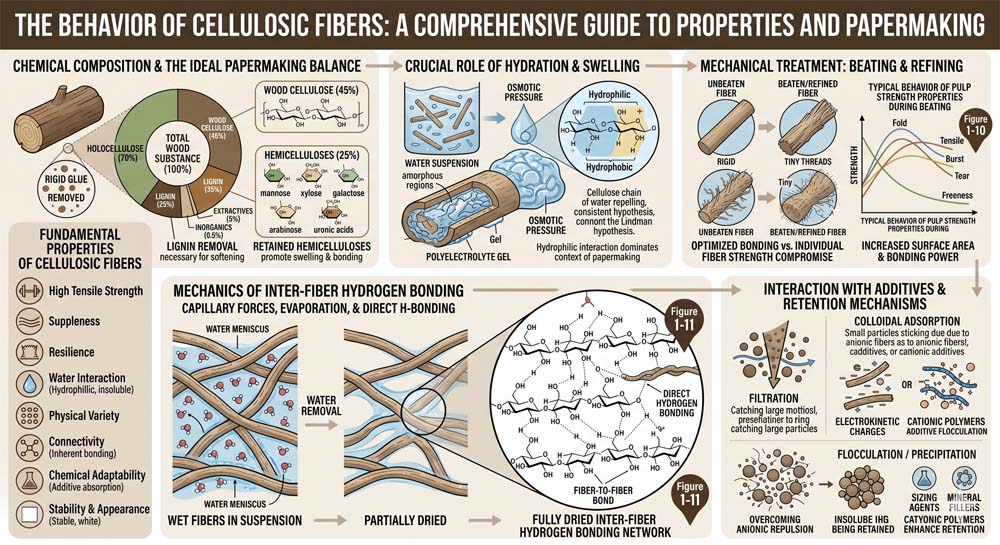
The primary structural framework of wood is the holocellulose, which accounts for approximately 70% of the total wood substance. Holocellulose represents the total polysaccharide fraction, which can be further broken down into wood cellulose at 45% and hemicelluloses at 25%. The remaining components making up the total wood substance include lignin at 25%, extractives at 5%, and a minor fraction of inorganics at 0.5%. Further acid hydrolysis of wood cellulose yields glucose along with traces of other carbohydrates and impurities. Conversely, the hydrolysis of hemicelluloses yields a variety of sugars, including mannose, xylose, galactose, arabinose, and uronic acids.
When optimizing these plant fibers for industrial use, a delicate chemical balance must be struck. In general, the best balance of papermaking properties occurs when most of the lignin is removed from the fibers while retaining substantial amounts of hemicellulose. Lignin acts as a rigid, water-resistant glue in the living tree; its removal is necessary to free and soften the fibers. Meanwhile, retained hemicelluloses play a critical role in promoting moisture uptake, fiber swelling, and eventual inter-fiber bonding.
Fundamental Properties of Cellulosic Fibers
The suitability of cellulosic materials for manufacturing is governed by an intrinsic set of physical and chemical traits. The key properties of cellulosic fibers include:
- High Tensile Strength: Individual fibers possess a naturally high tensile strength, which provides the underlying structural integrity of the final web.
- Suppleness: They exhibit excellent flexibility and conformability, allowing them to bend and intertwine without fracturing.
- Resilience: The fibers show a robust resistance to plastic deformation, meaning they can endure mechanical stress without permanently losing their original structural shape.
- Water Interaction: While the fibers themselves are completely water insoluble, they are highly hydrophillic.
- Physical Variety: They naturally provide a wide range of dimensions depending on the biological source of the wood or plant.
- Connectivity: The fibers possess a strong, inherent bonding ability that activates during the drying process.
- Chemical Adaptability: They show a distinct ability to absorb modifying additives introduced during the manufacturing process.
- Stability and Appearance: They are chemically stable over time and are naturally relatively colorless or white.
The Crucial Role of Hydration and Swelling
Because the papermaking process occurs in an aqueous medium, the hydrophillic nature of cellulosic fibers plays an important role. The fibers readily absorb water and are easily dispersed in a water suspension.
When submerged, water penetrates the amorphous (unordered) regions of the cellulose and hemicellulose structures. Modern polymer science describes this swelling behavior as akin to a polyelectrolyte gel, driven by osmotic pressure generated by weakly acidic groups within the fiber wall. As the fiber wall takes on water, it plastisizes and expands. This swelling softens the fiber, drastically improving its conformability. Recent scientific discussions, such as the Lindman hypothesis, also highlight that cellulose possesses amphiphilic characteristics—meaning it has both hydrophilic (water-attracting) and hydrophobic (water-repelling) zones. However, in the context of commercial papermaking, it is the hydrophilic interaction that dominates the suspension, dispersion, and preliminary network formation.
Mechanical Treatment: Beating and Refining
While chemical pulping successfully isolates the fibers, mechanical action is required to unlock their true physical potential. Properties are also greatly optimized by a mechanical treatment (e.g., beating or refining), which causes removal of the primary fiber walls and allows the fibers to hydrate (i.e., take water into the structure) and swell, increasing their flexibility and bonding power.
The impact of this mechanical treatment is profound but involves a strategic compromise. As beating time progresses, properties such as Fold, Tensile, and Burst strengths steadily climb, reflecting a stronger, more consolidated paper sheet. Conversely, Tear strength peaks early on and then experiences a sharp, continuous decline. During this same operational progression, the Freeness of the pulp—a measure of how quickly water drains from the fiber suspension—steadily decreases.
This inverse relationship highlights a fundamental principle of cellulosic networks. While individual cellulosic fibers generally have high tensile strength, the strength parameters of paper are more dependent on the bonds between fibers. Beating or refining tends to optimize bonding at the expense of individual fiber strength. The intense shear and compression forces of refining partially damage the fibers to fibrillate their external surfaces, increasing the available surface area for connection. Naturally, the original fiber strength depends on the nature of the raw material and the method of pulping.
The Mechanics of Inter-Fiber Hydrogen Bonding
The true marvel of cellulosic fiber behavior is observed during the transition from a wet suspension to a dry, solid sheet. When wet fibers are brought together during the sheet-forming operation, bonding is promoted by the polar attraction of the water molecules for each other and for the hydroxyl groups covering the cellulose surface.
As water is actively drained and mechanically pressed from the web, capillary forces draw the highly conformable, swollen fiber surfaces into intimate contact. This microscopic proximity is absolutely essential for inter-molecular interactions to take hold. When water is evaporated from a formed sheet, the hydroxyl groups on opposing fiber surfaces ultimately link together by means of hydrogen bonds.
The transition to a fully bonded state is progressive and happens in distinct layers. Initially, the cellulosic surfaces interact loosely through water molecules. As evaporation continues, the molecular connection tightens, occurring more tightly through a monolayer of water molecules. Finally, as the last microscopic layers of water are baked away, the hydroxyl groups of adjacent cellulose modules link directly to one another. This direct hydrogen bonding, often accompanied by the interdiffusion of polymer chains across the fiber-to-fiber interface, results in a remarkably cohesive and robust final material.
Interaction with Additives and Retention Mechanisms
Pure cellulose networks rarely meet all the specialized demands of modern commercial applications; therefore, the introduction of non-fibrous additives is widely utilized. Since non-fibrous additives are often used in the manufacture of paper products, the ability of the pulp fibers to retain a wide variety of modifying materials during sheet-forming operations is important. These additives range from sizing agents that control liquid penetration to mineral fillers that improve opacity, brightness, and printability.
The successful retention of these particles relies on multiple interacting mechanisms within the wet-end of the paper machine. Filtration, chemical bonding, colloidal phenomena, and adsorption are involved in the retention of particles. Filtration is suitable for larger particles, but other mechanisms are more important for retaining smaller particles and colloids. Because the cellulosic fibers and many common additives naturally carry anionic (negative) surface charges in water, they naturally repel each other. To overcome this, retention is enhanced by flocculation or precipitation of the insoluble material and by optimal adjustment of the electrokinetic charges within the system using cationic polymers.
Furthermore, for substances that dissolve seamlessly into the process water, direct chemical interaction dictates success. The ability to absorb or adsorb soluble additives is dependent on the relative chemical “affinity” of the pulp fibers.
Summary
The behavior of cellulosic fibers is a testament to the versatility of natural polymers. From their initial separation from the complex wood matrix to their highly responsive, gel-like behavior in aqueous environments, these fibers offer an unparalleled blend of strength, flexibility, and bonding capability. Through careful chemical extraction, precise mechanical refining, and controlled drying, industry professionals can masterfully manipulate the hydration and hydrogen-bonding potential of cellulose to create everything from standard packaging to cutting-edge nanomaterials.