Paper is everywhere—books, packaging, tissues, photocopy sheets, newsprint, paper cups, and even specialty industrial applications. But behind every sheet of paper lie microscopic fibers that determine its strength, texture, brightness, and durability. These fibers can come from trees, plants, recycled paper, and even textile waste. As sustainability becomes a global priority, understanding the sources of paper-making fibers is more important than ever for businesses, consumers, and environmental regulators. Here we explains the major fiber sources used in papermaking, how they differ, and why choosing the right fiber matters.
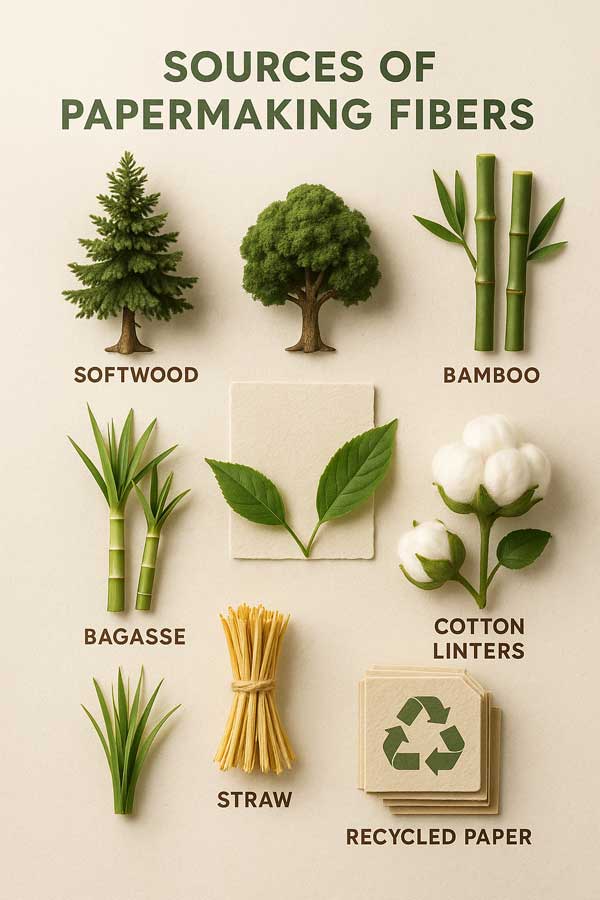
Main Sources of Paper-Making Fibers
1. Wood Fibers (Primary Source – ~90% of Global Paper)
Wood remains the most widely used raw material in the global pulp and paper industry.
Softwood Fibers
Softwoods come from coniferous trees such as: Pine, Spruce, Fir, Cedar, Hemlock.
Key Characteristics:
- Long fibers (2–4 mm)
- High tear strength
- Better tensile properties
- Ideal for reinforcement pulp
Uses:
- Packaging papers
- Kraft paper
- Sack paper
- Strength layers in paperboard
Hardwood Fibers
Hardwoods come from deciduous species like: Eucalyptus, Acacia, Birch, Poplar, Aspen etc.
Key Characteristics:
- Short fibers (0.7–1.2 mm)
- High opacity
- Smooth surface
- Better printability
Uses:
- Printing & writing paper
- Tissue & toilet paper
- Coated papers
- Fine papers
Why Wood Dominates the Industry
- High cellulose content
- Established supply chain
- Efficient pulping technologies
- Predictable fiber quality
- Can be sustainably managed through forestry certification (FSC, PEFC)
2. Non-Wood Plant Fibers (Agricultural & Alternative Fibers)
Non-wood fibers contribute around 6–10% of the world’s paper production, especially in Asia and developing markets.
a) Bamboo
- Fast-growing, renewable
- Strong fibers
- Popular in China, India, Bangladesh
- Uses: Tissue, packaging, writing paper, specialty papers.
b) Bagasse (Sugarcane Residue)
After extracting sugar from sugarcane, the leftover fiber becomes an excellent pulp source.
Benefits:
- Abundant agricultural byproduct
- High brightness capability
- Smooth sheet formation
- Used in: Food packaging, tissues, printing paper, molded products.
c) Wheat Straw & Rice Straw
Common in South Asia & Middle East.
Characteristics:
- Short fibers
- Lower strength
- High silica content (affects chemical recovery)
Used in: Newsprint, packaging, low-grade writing paper.
d) Cotton Linters & Textile Waste
- Very high cellulose purity (almost 90–95%)
- Used for premium grades
Applications:
- Currency paper
- Security paper
- Archival paper
- Filter papers
e) Hemp, Kenaf, Jute
- Long, strong fibers
- Eco-friendly
- High yield
Used in: Specialty packaging, eco-friendly paper, composites.
Advantages of Non-Wood Fibers
- Short rotation crops
- Lower environmental footprint
- Good for countries with limited forests
Challenges
- High silica (in straw)
- Supply chain limitations
- Higher processing costs
3. Recycled Paper Fibers (Secondary Fiber Source)
Recycled paper contributes 55–65% to global paper manufacturing. Countries like Germany and Japan have recycling rates above 70%.
Types of Recovered Paper
- OCC (Old Corrugated Containers) – Used for brown packaging paper.
- ONP (Old Newspapers) – Used for newsprint and insulation material.
- Mixed Waste Paper – Lower-quality products.
- Office Waste (White cuttings) – Recycled printing paper.
Benefits of Recycled Fibers
- Reduces dependence on virgin pulp
- Lowers carbon footprint
- Saves water & energy
- Supports circular economy
Limitations
- Fiber length reduces with each recycling cycle
- Contamination issues
- Limited use in premium papers
Fact: A paper fiber can be recycled 3–7 times before it becomes too short for reuse.
Papermaking Fiber Sources: Comparison Table
| Fiber Source | Strength | Cost | Sustainability | Typical Use |
| Softwood | ⭐⭐⭐⭐⭐ | Medium | High | Packaging, kraft paper |
| Hardwood | ⭐⭐⭐⭐ | Medium | High | Tissue, printing |
| Bamboo | ⭐⭐⭐⭐ | Low | Very high | Tissue, packaging |
| Bagasse | ⭐⭐⭐ | Low | Very high | Food packaging |
| Straw | ⭐⭐ | Low | Medium | Newsprint |
| Cotton Linters | ⭐⭐⭐⭐⭐ | High | Medium | Currency, archival |
| Recycled Paper | ⭐⭐⭐⭐⭐ | Very low | Very high | Packaging, newsprint |
How Fiber Properties Affect Paper Quality
Key Fiber Characteristics
- Length: impacts strength
- Diameter: affects sheet density
- Lignin content: influences brightness/bleaching
- Fibrillation: contributes to bonding
- Chemical composition: cellulose, hemicellulose, lignin
Fiber Mixing Strategy
Paper mills rarely rely on one type of fiber. Instead, they blend fibers for optimal performance.
Example:
Softwood pulp + hardwood pulp = strong + smooth sheet for printing papers.
Sustainable Trends in Fiber Sourcing
Modern paper mills focus on:
- FSC & PEFC certified wood
- Increased use of agricultural residues
- Closed-loop recycling systems
- Bio-based chemical pulping
- Low-carbon production technologies
Eco-friendly alternatives like bamboo, bagasse, and hemp are gaining popularity due to climate concerns.
Conclusion
Paper-making fibers come from a diverse range of sources, each offering unique qualities. From traditional wood pulp to innovative agricultural residues and recycled materials, the industry is continuously evolving to balance performance, cost, and sustainability.
Understanding the sources of papermaking fibers helps businesses make responsible procurement choices and allows readers to appreciate the complexity behind everyday paper.
FAQ
1. What are the main sources of paper-making fibers?
Wood fibers (softwood & hardwood), non-wood plant fibers (bamboo, bagasse, straw), and recycled fibers.
2. Which fiber is best for high-strength paper?
Softwood fibers provide exceptional tensile and tear strength.
3. Are non-wood fibers suitable for quality paper?
Yes, bamboo and bagasse produce excellent printing and tissue papers.
4. How many times can paper fibers be recycled?
Typically 3–7 cycles before the fibers become too short.
5. What is the most sustainable fiber source?
Bamboo, bagasse, and recycled paper have the lowest environmental footprint.
6. Why do mills mix different fibers?
To achieve an optimal balance of strength, smoothness, and cost.
7. Which countries use the most non-wood fibers?
China, India, Bangladesh, and Egypt lead in non-wood pulp usage.